💳 Banks and fintechs are pouring resources into new technologies—yet inefficiencies, delays, and customer frustrations still persist. This course is designed to give banking professionals and analysts the tools to see beyond the systems, identify hidden waste, and redesign workflows that truly improve both operations and customer experience.
📌 Course Overview
Customer Effort & Flow — Surface where customers and teams feel friction.
💧 Case Study: Turning Around a Troubled Water Project with Lean Practices
🧭 At a Glance
A $2.1M Water and Sanitation (WASH) project in Western Kenya was at risk due to budget overruns, delays, and poor-quality work. With Lean practices and coaching support from Gwendo of SORTAgile, the project was successfully turned around—saving costs, improving quality, and re-engaging communities.
⏱ Latrine construction time cut from 3+ months → 1 month
⛏ Borehole drilling reduced from 6 months → 2 months
💰 $500,000 saved and reinvested in repairs, training, and water access
📈 On-time reporting improved to 90%
🤝 Community contributions delivered in 4 months instead of 8
🚦Stage 1: BEFORE- Fragmented Workflows
💸 13% budget overrun created funding strain
⏳ Delayed activities left Year 2 targets unmet
⚠️ Poor-quality work increased rework and repair costs
📉 Stakeholder confidence was falling as timelines slipped
💬 “Targets were slipping, quality was low, and costs were rising—jeopardizing the entire project.” — COO
🚦Stage 2: DURING -Lean Redesign
Though not yet certified, Gwendo applied Lean Six Sigma tools and guided the team through structured improvements:
🔍 Root cause analysis identified bottlenecks in drilling and latrine quality
📝 Standardized processes and clarified roles for accountability
📊 Introduced weekly reporting and value stream mapping for visibility
⚡ Embedded proactive risk mitigation practices
🤝 Increased community engagement to speed up local contributions
Quick Wins:
✅ Issues identified early, reducing costly rework
👥 Team alignment improved through clear responsibilities
📈 Community trust rebuilt via faster, more transparent progress
📈Stage 3: AFTER – Project On track
⏱ Latrine construction reduced from over 3 months → 1 month
⛏ Borehole drilling cut from 6 months → 2 months
💰 $500,000 saved and reinvested into serving 30% more beneficiaries
📊 On-time reporting climbed to 90%
🤝 Community contributions delivered twice as fast (4 months → 8 months)
💬 “Gwendo is a highly effective manager who excels in driving results across multiple areas. She balances details with the big picture, helping teams cut waste and deliver impact.” — Director of Strategic Priorities & Programs, STFM
The Journey in One Line
📉 Troubled Project ] →
🛠 Lean Redesign →
💧 Faster, Higher-Quality Delivery
✨ Transforming Projects Through Lean Practices
This case shows how Lean practices and coaching can salvage struggling projects—restoring efficiency, reducing costs, and strengthening community outcomes.
Need to serve more beneficiaries with less funding?
📱 Case Study: Improving Digital Product Delivery with Lean Process Mapping
🧭At a Glance
A technology and training company in Cape Town partnered with SORTAgile, receiving training and coaching support from Gwendo, to address inefficiencies in digital product delivery. By applying Lean process mapping, they aligned teams, simplified onboarding, and reduced waste—improving time-to-market for new apps.
🤝 Cross-functional collaboration improved
📊 Processes clarified across development, business, and accounts
⏱ Faster onboarding of new staff
💡 Rework and duplication reduced
🌍 Scalable process model to support future growth
🚦Stage 1: BEFORE- Fragmented Workflows
👥 Staff lacked awareness of key processes to complete tasks
🔄 Teams often reinvented solutions for already-solved problems
📑 No standardized approach for core organizational activities
📂 Existing process manuals were underused and difficult to follow
🕒 Onboarding new staff was inefficient due to lack of simplified guides
💬 “Without clear workflows, we wasted time re-explaining tasks and repeating mistakes.”
🚦Stage 2: DURING -Lean Redesign
SORTAgile facilitated a collaborative redesign using Business Process Mapping and BPMS software.
🗺️ Visualized parent processes for end-to-end project flow (e.g., mobile app development)
📋 Broke down sub-processes such as developing product specifications
👥 Engaged staff at all levels in workshops to validate and refine flows
📊 Clarified roles, decision points, and handovers
🔍 Identified potential delays and bottlenecks
Quick Wins:
✅ Team alignment improved as everyone could see “who does what, when, and with whom”
📈 Clear visual workflows doubled as training tools for onboarding new hires
🔄 Reduced duplication and delays by eliminating unnecessary steps
📈Stage 3:AFTER – Agile, Scalable Product Delivery
🤝 Cross-functional collaboration strengthened
📊 Clarity across teams improved productivity and accountability
⏱️ Faster onboarding using visual models instead of thick manuals
🗂️ Lean process maps became professional assets for donors and investors
🌍 Scalable model built to support future product delivery
💬 “The clarity we gained from this exercise has completely changed how we deliver projects. It was practical, visual, and inclusive.” — Team Member
The Journey in One Line
🔄 Fragmented Processes →
🗺️ Lean Process Mapping →
🚀 Agile & Scalable Delivery
✨Map It. See It. Fix It.
This case shows how visual Lean tools help tech teams cut ambiguity, improve delivery speed, and scale with confidence.
Love your team deliver digital products faster with less re-works?
📂 Case Study: Streamlining Audit Readiness Through Smart Filing
🧭 At a Glance
A humanitarian organization with multiple finance delegations partnered with SORTAgile, supported by training and coaching from Gwendo, to resolve major gaps in document filing during a global digital transformation. A simple Lean + tech-enabled tool cut verification time by 99% and restored confidence in audit readiness.
⏱ Verification time reduced from 3 hours → 2 minutes
📉 Missing files dropped from 158 → fewer than 5 per month
🌍 Tool adopted across 4 sites, with plans for scale-up
😀 Finance teams gained ownership and reduced reliance on auditors
🚦Stage 1: BEFORE- Missing Files & Manual Checks
📂 700+ files uploaded in January, but 150+ were missing on review
🌍 By February, 1,500 of 9,000 files were unaccounted for across delegations
🧾 Manual tracking was slow, error-prone, and exhausting
📉 Audit teams wasted time chasing missing files instead of focusing on compliance
💬 “We had no reliable way to confirm whether all documents were uploaded until auditors flagged what was missing.” Account Officer
🚦Stage 2: DURING -Lean Redesign
The team partnered with a data analyst to co-create a simple but powerful Excel-based tool that automated the verification process.
🧠 Extracted file names directly from the shared folder
📋 Compared them against the official monthly list of expected files
🚩 Flagged missing items instantly for proactive correction
Quick Wins:
✅ Finance teams could verify completeness themselves before submission
🔄 Control shifted from auditors back to local teams
📊 Staff used the tool regularly, embedding a new habit of self-checking
📈Stage 3: AFTER – Audit Confidence Restored
⏱ Verification time dropped from 3 hours → just 2 minutes
📉 Missing files reduced by 97% (from 158 → fewer than 5 per month)
🌍 Adopted by 2 delegations across 4 sites, with rollout plans expanding
😀 Audit readiness improved, and staff confidence increased
💬 “This simple solution gave us real control over our filing process. We no longer wait for HQ to tell us what’s missing—it’s already done.” audit staff
The Journey in One Line
📂 Manual File Checking →
🛠️ Excel Tool →
✅ Audit Confidence
✨Lean Tech That Works — Without Big Systems.
This case shows how Lean leadership and coaching turn lost sales into recurring business through practical standardization and staff involvement.
💳 Case Study: Driving Efficiency at a Mid-Sized MFI in Kampala
🧭 At a Glance
A mid-sized Microfinance Institution (MFI) in Kampala partnered with SORTAgile, supported by training and coaching from Gwendo, to address inefficiencies in loan approvals, client onboarding, and internal workflows. By applying Lean management principles, the MFI streamlined its operations, cut costs, and positioned itself for growth.
⏱ Loan processing accelerated by 40%
💰 Operational costs reduced by 25%
⚡ Faster decision-making across loan approvals and customer service
🤝 Improved teamwork and role clarity
🌱 Institution prepared for sustainable growth
📈 Asset loan target exceeded by 150%
🚦Stage 1: BEFORE- Operational Inefficiencies
👥 Staff unclear about roles and responsibilities → duplicated efforts
📝 Loan approval and client onboarding lacked standardized steps
🕒 Slow decisions delayed loan approvals and service
📑 Manual paperwork consumed significant time and resources
💬 “We were serving clients, but the way we worked slowed us down and limited how many people we could reach.”
📋 Designed standardized step-by-step procedures for clarity and consistency
📊 Introduced visual tools (flowcharts, Kanban boards) to track work and delays
👥 Facilitated staff workshops to secure buy-in and alignment
📈 Set up performance tracking systems to measure progress and sustain results
Quick Wins:
✅ Clearer roles reduced mistakes
⚡ Loan approvals sped up with standardized steps
🙌 Staff gained ownership by co-designing processes
📈Stage 3: AFTER – Faster, Leaner, Ready to Grow
⏱ Loan processing time cut by 40%
💰 Operational costs reduced by 25%
⚡ Faster decision-making improved client service
🤝 Clear roles boosted collaboration and teamwork
🌱 Efficient workflows enabled scaling without adding more staff
📈 Asset loan target exceeded by 150%, PAR 60 at 2.5%
💬 “The Lean approach has made a big difference. We’re now serving more clients with less effort, and our team works together better than ever. We even attracted more funding as a result of improved performance.” — WaterCredit Manager
The Journey in One Line
📝 Paper-Heavy & Slow →
🛠 Lean Redesign →
⚡ Faster, Scalable MFI
✨Lean Driven Growth
This case demonstrates how Lean management principles, combined with hands-on coaching, can help MFIs eliminate waste, improve service, and strengthen their capacity for growth.
Need to Grow your Loan Portfolio while Reducing PAR?
🏭 Case Study: Prevent Supply Shortages with a Standard Ordering Guide
🧭At a Glance
A leading CO₂ supplier partnered with SORTAgile, supported by training and coaching from Gwendo, to stop recurring stock-shortages at customer sites. By co-developing a simple ordering guide with staff and clients, they prevented emergency reorders and protected revenue.
⏱ Emergency reorders reduced by 90%
📦 Customer orders grew from 10 MT → 24 MT per quarter
🤝 Improved trust and reliability with clients
🔄 Standardized model replicable for future accounts
🚦Stage 1: BEFORE- Frequent Stock-Outs
📉 Customers often ran out of CO₂, halting production
🛑 No clear guidance on monitoring or reordering
💸 Telemetry systems too costly or non-functional
📑 Ordering and receiving procedures inconsistent
Impact: An estimated Ksh 5M in annual lost revenue from one client. 💬 “New customers weren’t walked through the stock monitoring and ordering process. When they ran out, they rushed to competitors.”
🚦Stage 2: DURING -Lean Redesign
SORTAgile supported the Chief Commercial Manager and delivery team to create a practical “How-To” Ordering Guide.
📊 Introduced a reorder formula (consumption + safety stock)
📝 Standardized LPO process and approvals
🚛 Clear delivery timelines and receiving checklist
🧤 PPE, COA, and documentation requirements added
Quick Wins:
👥 Delivery staff engaged in co-design for ownership
📅 Customers aligned on reorder levels and SLAs
📄 Guide explained, printed, and shared with clients
📈Stage 3: AFTER – Reliable Ordering and Delivery
⏱ Emergency stock-outs eliminated
📦 Orders expected to grow from 10 MT → 24 MT per quarter
🤝 Stronger client-supplier trust
🔄 Standardized guide adopted as model for future onboarding
💬 “This guide will work as a backup whether the customer has telemetry or not. Good idea—I will share the guide with our logistics team now.” — Client Representative
The Journey in One Line
⚠
Unplanned Stock-Outs →
📝 Standard Ordering Guide →
📦 Reliable Supply & Growth
✨Small Guide. Big Impact.
This case shows how Lean leadership and coaching turn lost sales into recurring business through practical standardization and staff involvement.
Could clear guides help your teams serve customers better?
🚢 Case Study: Streamlining Port Payments & Clearance
🧭 At a Glance
Faced with mounting delays and rising costs at the port, a regional logistics team partnered with SORTAgile for hands-on training and coaching support from Gwendo. Together, they transformed port payments from a rigid manual process into a faster, flexible workflow.
The Result?
⏱ Payment processing cut 83%, from 6 hours → under 1 hour
📦 Clearance delays reduced from 50%, 2 days → 1 day
💰 Storage charges slashed by 70%
🛵 Rider delivery costs down by 80%
😀 Fewer customer complaints and stronger SLA performance
🚦Stage 1: BEFORE- Manual Bottlenecks
The team mapped the entire clearance workflow, uncovering waste in:
🖊 Required 5 approvers to sign cheques
🏍 Rider had to deliver cheques to the port daily
📅 Delays whenever signatories were unavailable
🕒 Payment confirmation could take over 24 hours
Impact:
💸 Extra storage charges
📉 SLA breaches and customer complaints
💰 Strained cash flow
💬 “We were losing time, money, and customer trust due to a rigid process that didn’t match operational urgency.”
🚦Stage 2: DURING -Lean Redesign
After reviewing the current process, a Lean process redesign introduced three major changes:
🏦 Opened a bank account at the port for direct payments
📝 Introduced pre-signed weekly cheques (2 signatories instead of 5)
📅 Structured weekly reconciliation by the port supervisor
🚗 From Drop-Offs to Digitization-Tranforming Insurance Onboarding.
🧭 Overview
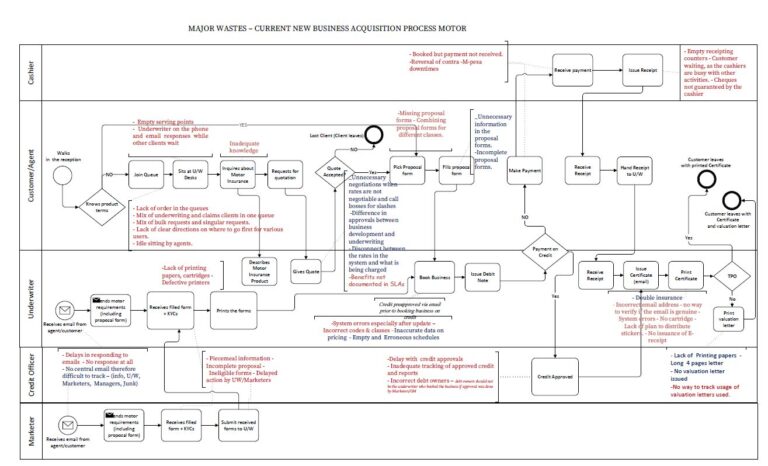
A leading insurance provider, struggling with inefficiencies and customer frustration in its motor insurance onboarding, partnered with SORTAgile for hands-on training and coaching support from Gwendo. Together with an internal improvement team—the Change Pioneers—they turned a manual, error-prone process into a streamlined digital workflow.The impact was clear:
⏱ Processing time cut by over 50%
📦 Errors reduced and proposals completed more accurately
🙌 Staff ownership and engagement grew through leading the change
🚦 Stage 1: BEFORE – Manual Chaos
We began with a full process mapping exercise which revealed the following Inefficiencies (wastes):
🕰️ Long queues and idle agents due to unclear customer flow
📝 Frequent errors and incomplete proposal forms
📄 Valuation letters spanned 4 pages—difficult to print or track
💳 Delayed and inconsistent credit approvals
🔐 Underwriters couldn’t update system values
🕵️♀️ Valuation reports and valuers were hard to trace
😤 High drop-off rates (40%)due to customer frustration
💬 “The process overwhelmed staff and confused customers—leading to lost opportunities.”
🛠️ Stage 2: DURING – Lean Process Redesign (Led by SORTAgile)
Key Improvements:
🗘️ Mapped and simplified onboarding for both walk-ins and email channels
⚠️ Introduced risk assessment before booking
✅ Digitized and redesigned proposal forms for clarity and completeness
📄 Introduced a single-page valuation letter
🔄 Centralized communication for consistent follow-up
📊 Monitored valuer activity with shared trackers and weekly reviews
Quick Wins:
⬇️ Fewer drop-offs (10%)
🔄 Less rework on proposals
🤝 Improved collaboration between Underwriting and Claims
⚙️ Stage 3: AFTER – Enhanced Digital Flow
Lean Tech Enhancement:
💻 Digital workflows established for onboarding and endorsements
🔍 Integrated risk and credit checks into the core system
✅ Realtime KYC screening and validation
🧾 Correct and updated policies loaded and generated automatically at endorsement
📊 Dashboards replaced manual tracking tools
⏱️Processing time reduced by over 50% - 70% (email - walk-ins)
Outcomes::
😀Increased customer satisfaction
⚡ Smarter use of existing technology and resources
🕒Faster, more accurate policy issuance
🙌 Higher engagement levels from staff through ownership of change
💬 “SORT Agile helped us turn a frustrating process into a digital experience our customers actually appreciate. What’s more, our teams led the change—and they’re proud of it.”
— Acting CEO
The Journey in One Line
🕰️ Manual Chaos →
🛠️ Lean Redesign →
⚙️ Enhanced Digital Flow
✨Smarter Systems. Happier Customers.
This case shows how Lean + Tech unlocks smarter use of existing systems—maximizing value without heavy new investments. Each phase delivered measurable improvements in workflow efficiency, team coordination, and customer experience.
How much more value could your existing systems deliver?
Lead Projects, Coach Others, and Drive System-Level Change
*This course builds on Yellow Belt Certification.
Green Belt prepares you to lead solutions—guiding teams, coaching change, and aligning improvements with business goals. You’ll strengthen your ability to analyze processes, prevent mistakes, and reduce variation. Some tools may be familiar from earlier levels, but now you’re expected to apply them in real work—coaching others, navigating complexity, and driving measurable results in your organization.
🧠 Lean Thinking at the Next Level
Aligning improvement work with organizational strategy and key performance indicators (KPIs)
Leading change in complex, cross-functional environments
Adapting Lean for digital, service-based environments: Explore how Lean principles apply to work driven by information, systems, and tech—not physical products
Lean Leadership and the role of leaders, coaches, and improvement teams
Process maps, SIPOC, Subject-Verb-Direct Object method
SOPs, Work Instructions, Checklists
Standardizing the best-known way to work
💡 Value & Waste
Defining value from the customer’s point of view
Required vs. non-value-adding work
The 3 types of waste: Muda (waste), Mura (unevenness), Muri (overburden)
Deep dive: TIMES EDGE and the 9 wastes of Lean
⛔ Mistake-Proofing & Prevention
Preventing errors, defects, and failures
Simple, cost-effective mistake-proofing tools
Introduction to FMEA (Failure Mode & Effects Analysis)
♻️ Make Work Flow
From push to pull: Responding to customer demand
Reducing batch size, leveling workloads
Kanban, cycle time, takt time, span time, touch time
🧠 Solve Root Causes
PDCA and scientific thinking
5 Whys, Fishbone diagrams
A3 thinking and Toyota Kata
DMAIC for larger problems
🧑🤝🧑 Facilitate Teams & Coach Change
Team dynamics and facilitation skills
How to manage change and influence others
Lean leadership: Empowering teams to own improvement
Bringing out the best in people
📈Bonus Topics
Variation: Highlights and hidden causes
Daily stand-up meetings
Ask 3 Questions method
Sustaining momentum through continuous learning
🧩 Certification Requirements & Application
To earn your Green Belt certification, you must:
Attend and actively participate in the Lean Green Belt training, completing the exercises
Pass the Lean Green Belt test
Conduct a Green Belt project—either a full DMAIC project or a series of smaller improvements—with documented and measurable results. This project must clearly demonstrate your understanding and application of Lean thinking, tools, and methods in your real work environment.
🎓 After the course, you’ll walk away with:
A recognized Lean Six Sigma Green Belt certification
The confidence to lead small to mid-sized improvement projects
A deeper understanding of Lean tools, team facilitation, and change leadership
Skills to coach, influence, and guide others through meaningful change
*This course builds on concepts covered in the White Belt certification.
While White Belt helps you see problems, Yellow Belt equips you with tools to solve them—clearly, confidently, and with measurable impact. You’ll learn to define issues precisely, analyze root causes, and apply structured methods like DMAIC to improve processes. Whether working independently or within a team, you’ll build skills to cut waste, raise quality, and drive lasting change.
Build Awareness, Improve Work, and Make a Difference
This certification goes beyond awareness—it helps you change how you approach challenges at work. You’ll learn to identify everyday problems, reduce delays, and apply practical fixes that improve team performance, customer experience, and how it feels to get work done. With relatable examples, guided reflection, and real workplace application, the course builds lasting confidence to drive meaningful change.
🎯 Process Energizer Simulation
Step into a live experience where things go wrong—then learn to step back, reflect, and make thoughtful changes.
This exercise teaches how process issues—not people—cause frustration and how to improve outcomes without blame.
👥 Improving the Customer Experience
Understand the 3 main customer frustrations
Customer satisfaction vs. experience
Net Promoter Score vs. Customer Effort Score
Why loyalty matters
The role of process design in reducing friction and improving trust
🧠 Lean Thinking Basics
Lean as a mindset—not just methods
Pitfalls of automating poor processes
A better way to think about improvement in everyday work
⚠️ The Inefficiency Triangle
Overburden (Muri), Inconsistency (Mura), and Waste (Muda)
Type I vs Type II Non-Value Add
Explore TIMES EDGE, a practical way to spot inefficiencies (8+1 Lean wastes (non-manufacturing lens)
🔄 Seven Habits of Process Improvement
Organize the area
Make work visible
Standardize work
Eliminate waste
Prevent mistakes
Make workflow
Solve problems
🎯 Toyota Kata
Understand different causes for performance gaps
Learn the difference between improving what bothers you vs. what matters strategically
Practice a simple routine for continuous improvement through real-world examples
🧩 Certification Requirements & Application
To successfully complete this course, participants must:
Actively engage in all aspects of the training program.
Complete a simple improvement at their workplace
🎓 After the course, you’ll walk away with:
A recognized White Belt certification
A fresh perspective on how work happens—and how it can improve
Practical steps to contribute to positive change in your team or organization
 Why join?
 Understand the 9 Lean wastes (TIMES EDGE) that slow down service and tech work.
 Learn through real-world examples you can relate to immediately.
 Build a shared language with your team to identify and reduce waste.
 Walk away with practical steps you can apply the same day.
 Perfect for:
 Quick Course—Lasting Impact
 Lean Banking Essentials
 Customer Effort & Flow — Surface where customers and teams feel friction.
 Lean Foundations for Banking — Why waste reduction matters (Muda, Mura, Muri).
 Apply the 9-Wastes Lens — Use the TIMES EDGE perspective across onboarding/KYC, underwriting, payments, servicing, and digital/branch ops.
 Impact & Metrics — Tie fixes to turnaround time, rework, risk, and Customer Experience.
 Wrap-Up & Assignment — Apply the method to your own workflow and earn a certificate.
 What You’ll Gain
 Faster detection of bottlenecks and handoff delays.
 Tools to prioritize fixes with data and customer effort.
 A recognized certificate of completion to strengthen your profile.
 Analyze. Improve. Perform.